Belief Is a Choice: How Our Minds and Experiences Shape Truth
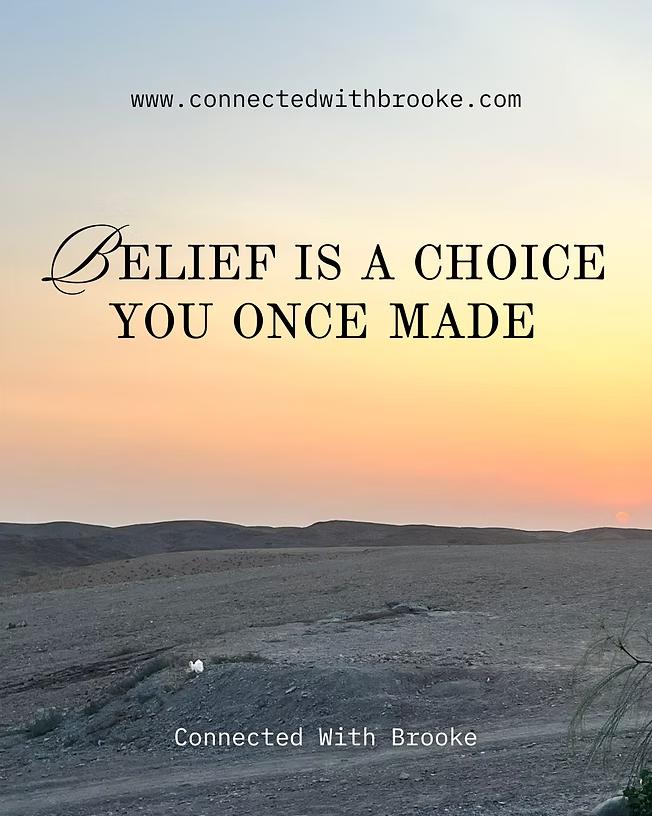
Belief is nothing more than a choice you once made that eventually became your truth.
Maybe you remember the moment you chose it. Or maybe, like so many of our beliefs, your mind made the choice for you quietly and efficiently, without ever asking for your consent.
It adopted the belief to complete a task. To create safety.To resolve confusion. To check a mental box connected to a feeling you once had and did not yet know how to hold.
And once that belief did its job, it stayed.
Over time, repetition turned it into certainty. Certainty turned it into identity. Eventually, it felt like the truth, even if it was never consciously chosen at all.
I am aware that I am nothing more than a collection of choices. My truth is a conscious effort, one I actively participate in. It is always subject to change the moment I learn something new and feel ready to replace it with updated data that supports my growth.
I do not cling to beliefs for the sake of comfort or familiarity. What I hold as true today is simply the most aligned understanding I have access to right now. I remain open to expanding or releasing it at any moment.
That awareness alone has changed how I relate to everything I believe.
A Preface on Truth, Belief, and Not Knowing
I want to begin this by saying I do not actually know if what I am about to share is fiction or nonfiction.
I do not know if I read this somewhere once, overheard it in a conversation, absorbed it through experience, or completely made it up on my own. That awareness feels important to name because it mirrors how I approach most of what I believe.
Some of what I hold as truth today has no clear origin story. I am grateful for that. It reminds me that my beliefs are not fixed monuments but living, breathing things, allowed to shift, soften, expand, or dissolve as I grow.
Can I speak with one hundred percent confidence in what I feel, teach, or say? Yes, within my current truth.
I also believe there is wisdom in knowing that we do not actually know anything with absolute certainty. We choose the belief that feels closest, most resonant, most useful, and we move forward with it. Even our education, even what we are taught as fact, could be incomplete or wrong. Yet we allow it to become truth because, at some point, it helped us make sense of the world.
That awareness is not destabilizing to me. It is freeing.
With that said, today I want to talk about my personal relationship with deities and how my understanding of them has changed as my mind has opened.
From Judgement to Curiosity
There was a time when I believed that people who followed certain religions or spiritual practices literally worshipped the physical figures themselves.
An elephant-headed god with a broken tusk.A figure with multiple arms.Characters that, through my old lens, felt cartoonish or naive.
From the rigidity of my former belief system, I remember thinking, how could an entire population worship something so made up? I did not question my judgment. I trusted it. I saw through a narrow window and assumed that was the whole landscape.
Then something shifted.
Not suddenly. Not dramatically.More like a light switch that flipped on and never turned off again.
As I began opening my mind to new experiences, new cultures, and new ways of understanding, the judgment lens quietly fell away. In its place came depth, curiosity, and awareness.
I started seeing how easy it is to judge when our beliefs are limited and how much richer the world becomes when we allow all possibilities to be discoverable.
Deities as Language, Not Literalism
What I see now is this.
Deities are not about the character.
They are stories. Sutras. Scriptures. Symbols.They are teaching tools, visible forms used to carry invisible principles.
The character gives the mind something to hold onto, but the meaning lives beneath the surface.
For example, Ganesha.
I used to see an elephant.
Now I see a reminder.
A reminder of intention. Of wisdom. Of humility. Of beginning again.A reminder that obstacles are not punishments but invitations to grow, to adapt, and to reroute.
The story is not about believing a physical figure is roaming the universe, removing roadblocks on our behalf. It is about anchoring a belief, a principle, and a way of relating to life.
When I understand it this way, it no longer feels foolish. It feels deeply intelligent.
Understanding Other Belief Systems Strengthened My Own
Learning about deities and religious systems outside of the one I was raised in was never about abandoning my own beliefs.
It was about understanding them more deeply.
Exposure did not dilute my faith or sense of truth. It clarified it. The more I learned how different cultures name meaning, morality, fear, love, and purpose, the more grounded I felt in my own internal compass. Understanding how others interpret the divine helped me see what I already believed, simply expressed through a different language.
These explorations did not pull me away from myself. They anchored me. They allowed me to resonate more clearly with what feels true in my body, not because it was familiar, but because it was tested against a wider understanding of how humans seek connection and explanation.
Learning about other belief systems gave me context. It helped me see the world as an interconnected whole rather than a collection of competing truths. Through that understanding, I felt more rooted, more present, and more aware of how we operate as people navigating meaning, uncertainty, and purpose.
What Changed Most
The biggest shift was not in how I see deities.
It was in how I see myself.
I no longer assume my first interpretation is the correct one.I no longer equate unfamiliar with wrong.I no longer mistake certainty for wisdom.
Now, I hold beliefs gently.
I let them teach me while also allowing them to evolve. I stay open to being wrong, not as a weakness, but as evidence that I am still learning. I remain deeply aware that what feels true today may look different tomorrow, and that does not invalidate either version.
It simply means I am still paying attention.
And maybe that is what belief was always meant to be.
Not a fixed destination.Not blind loyalty.
But a living, conscious relationship with meaning itself. As you sit with this, I invite you to look gently at some of the beliefs you currently hold.
Not to judge them. Not to discard them. Simply to notice them.
Ask yourself where they came from. Ask whether you chose them consciously or whether they were adopted quietly along the way to help you feel safe, understood, or certain at one point in your life.
Then consider this. Are those beliefs still serving who you are now?
If you were given new information, new experiences, or updated data that supported your growth, would you be willing to revise them? Would you allow your truth to evolve, not as a failure of the past, but as evidence of your continued awareness?
You do not need to have the answers. You only need the willingness to ask.
Because growth rarely requires certainty.It requires honesty, curiosity, and the courage to update what no longer fits.


